Campaign Autopsy Report - Everything You Need To File to Run

The first thing you need to know to start your illustrious campaign for West U City Council is that the City has a helpful website here with instructions on how to run. If you have any questions, the site also contains contact information for the City Secretary, who is extremely helpful and responsive.
That’s it. That’s all you need to know.
If you know this site exists, you’ll know more than I did when I said yes, two days before the filing deadline. In fact, I didn’t discover this site until long after I no longer needed it. I can’t even admit when I first found it, it’s too embarrassing.
I don’t even really need to write the rest of this post, but I will re-summarize anyway with a few tips in case it’s helpful:
Qualifications for Candidacy
At least 21 years of age
A resident of and have resided in the city for at least 12 months immediately preceding the election
Qualified to vote in the city
Term of Office
All 4 council seats (and the mayor’s) are up at the same time, every two years on the odd year. That means next chance to run will be 2027, 2029, 2031, etc.
Typically the filing deadline is some time in February, and election is in May. This year, the deadline was February 14, election May 3. That’s 78 days (longer if you don’t make the mistake of filing last minute like I did).
Paperwork to File
Application to have your name on the ballot
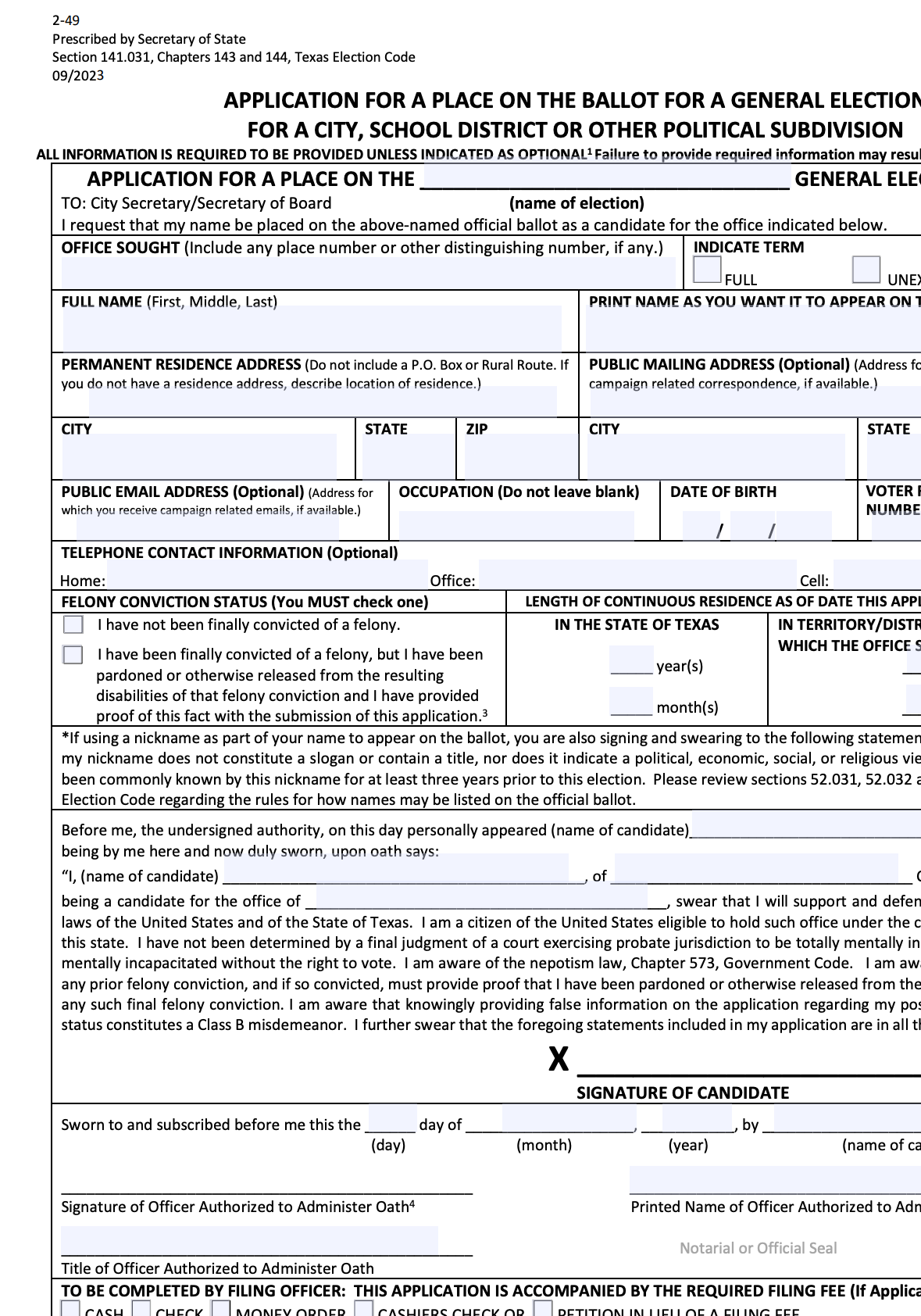
Pretty straightforward general application
Only real consideration is if the name you want on your ballot differs from your legal name, you’ll have to think about how best to do it. I am so well known as Mateo most people are surprised to know it’s not my legal name, so I definitely couldn’t have put Matthew. But I still didn’t want to open myself up to people claiming I was hiding or trying to be someone else, hence, Matthew “Mateo” Fisher. For most of you, this should be a nonissue.
Wait to sign until you hand it in to the City Secretary.
Appointment of Campaign Treasurer
If you are so lucky as to have someone who wants to be your campaign treasurer, give them this form to fill out, and hopefully they don’t change their minds.
Mostly straightforward, except for the one part you have to make your first major decision: are you going to raise/spend more or less than $1,100?
If less, sign page 2 and enjoy much easier reporting requirements.
If more, skip page 2 and prepare to fill out Campaign Finance Reports on the 30th day before the election, 8th day before election, and July 15 (i.e. after the election).
You should probably take a look at the Campaign Finance Report forms to see what you’re in for before making your decision. It’s not hard, but took me deceptively long even though I thought I was organized. Instructions are here, but they are dense. I’ll go into more detail on expenses on a later post, but keep in mind you’ll spend a minimum of $400-$500 for 100 signs. If all you did was buy signs, maybe some flyers, and a free website, it’s not impossible to get under $1,100. Noble even.
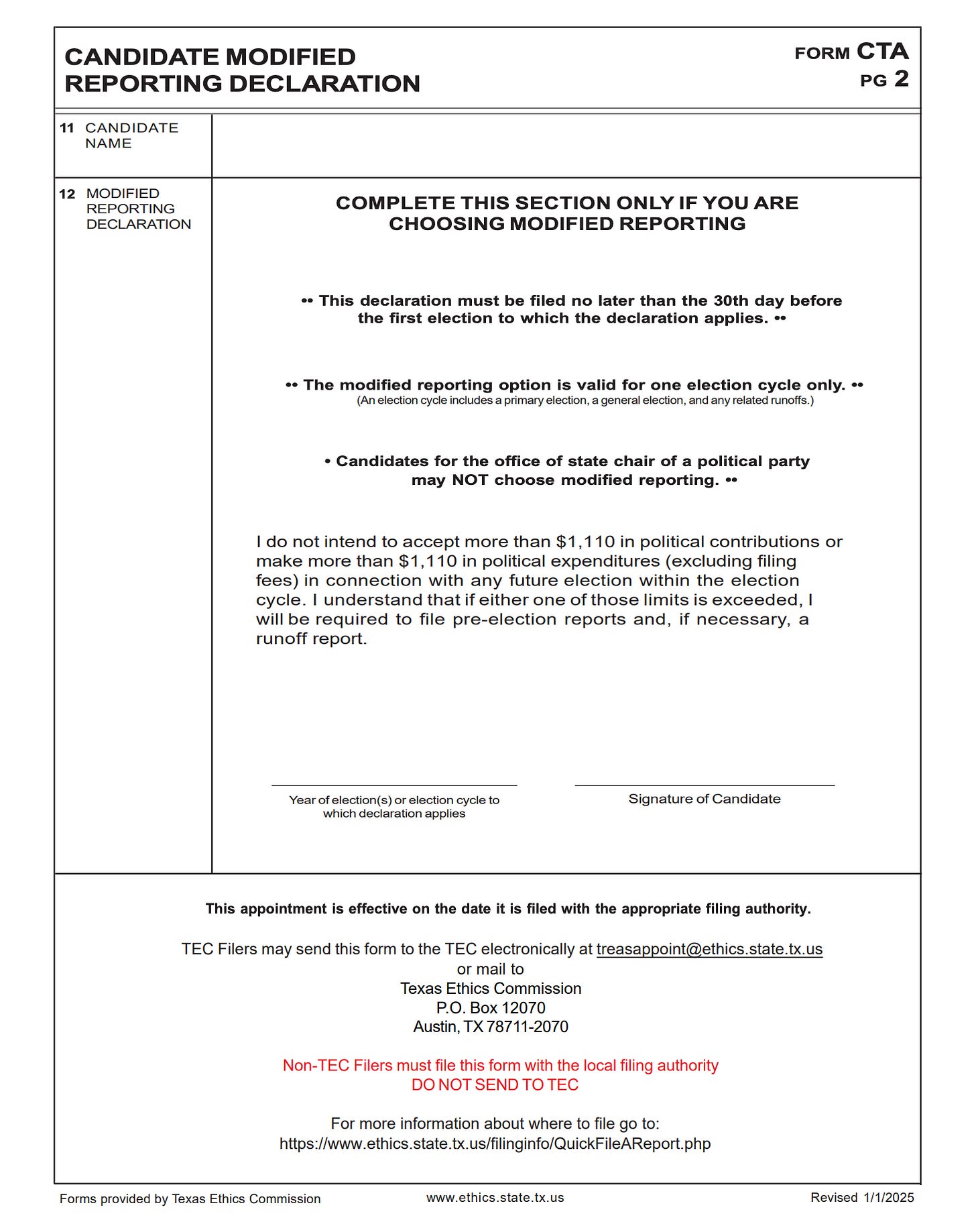
Will you opt to spend less than $1,100???
Authorization to Release Email Address
Another decision point. The email you provide on your application will be confidential unless you send in this optional form and allow people to contact you.
Best practice is probably to authorize, but not put your main email on your application. Not that I don’t trust people, but I don’t trust bots crawling the web looking for emails to spam. If that’s too complicated, go ahead and skip this form and don’t worry about it. I honestly don’t remember if I did this. I’m thinking probably not, and no one used it as an excuse to say I’m not transparent, so I don’t think anyone really cares.
Code of Fair Campaign Practices
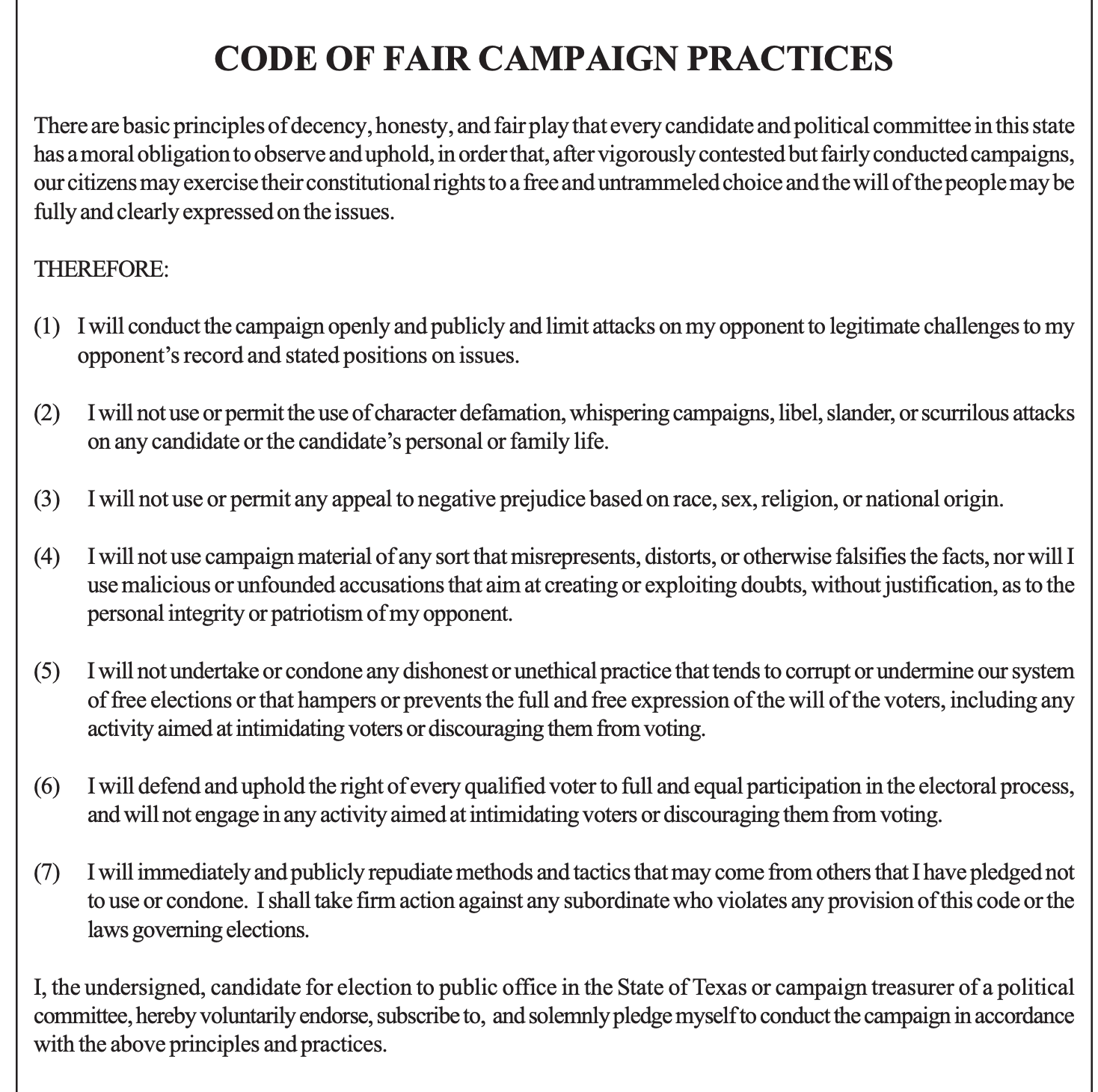
A code encouraging you to engage in a nice and honest campaign. Apparently, this is given to your Treasurer after they file your campaign appointment. If that happened to me, I missed it. I didn’t see this until well into the campaign. That’s okay, because it’s completely optional.
Even if I had known about it, I probably would have skipped this one. I find this kind of thing annoying. It is entirely optional, and there is no legal consequence for either following or violating it. What is the point of agreeing in writing not to engage in character defamation, whisper campaigns, libel, slander, or scurrilous attacks if there is no consequence for breaking that promise? The document is not enforceable and has no effect beyond appearances. The only real reason to sign it is virtue signaling, which I find unhelpful and a little distasteful.
My advice: follow the spirit of the code, keep it visible as a personal reminder if you like, but only sign and submit it if virtue signaling matters to you.
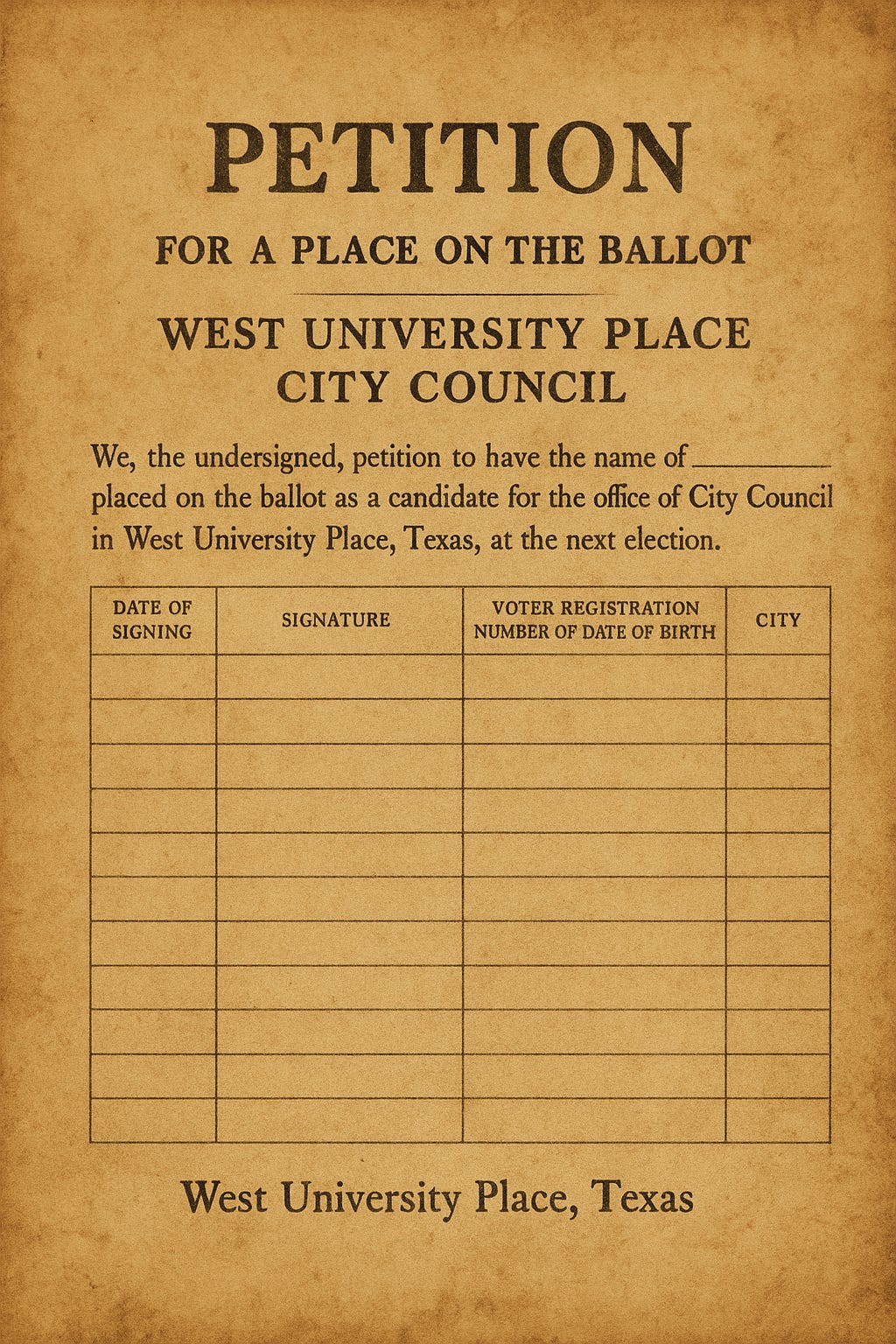
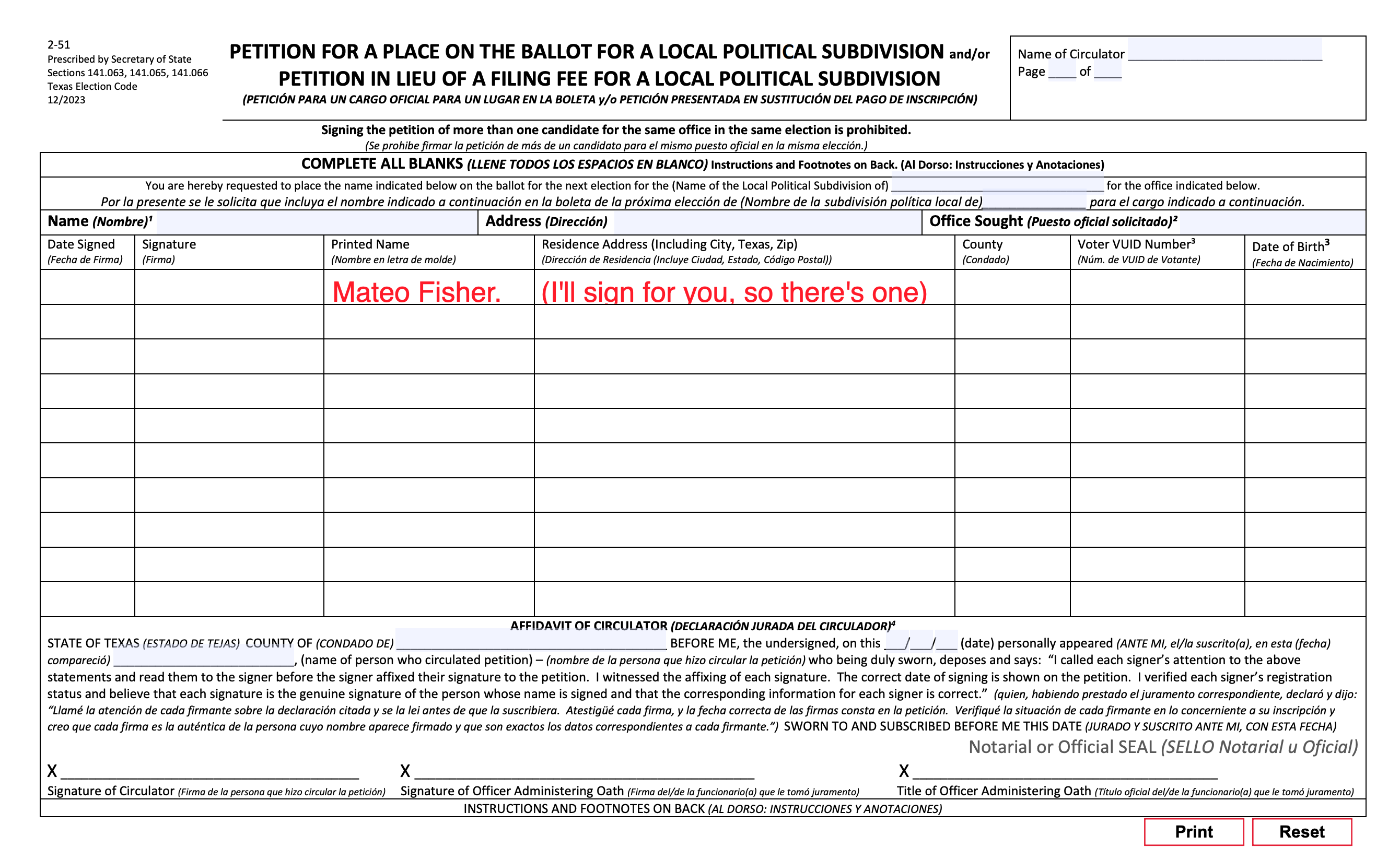
Petition for a Place on the Ballot
Now you’re doing something interesting. To get your name on the ballot, you need signatures of 25 registered voters who live in West U. It’s not too hard, but time-consuming if you leave it for the last minute and don’t work from home. I was so worried that I asked if I could be one of the signatures. Thankfully, it didn’t come to that (and I still don’t know the answer to that question).
You should tell your supporters VUIDs are optional, they can just put their birthdays instead. If they don’t want their birthdays, you can always look up their VUIDs here.
But you should get more than 25 signatures, just in case someone signs not realizing they aren’t actually registered to vote.
Don’t worry if someone has already signed a petition for someone else. Technically because there are four at-large positions, each voter can sign four petitions (and yes, I know this because someone tried to get me off the ballot this way).
Turn it all in to the City Secretary at City Hall before the deadline and you’re done
Congratulations! You’re officially on the ballot. I look forward to you asking for my vote.